Reading Coffee Origin Reports: A Home Barista’s Guide
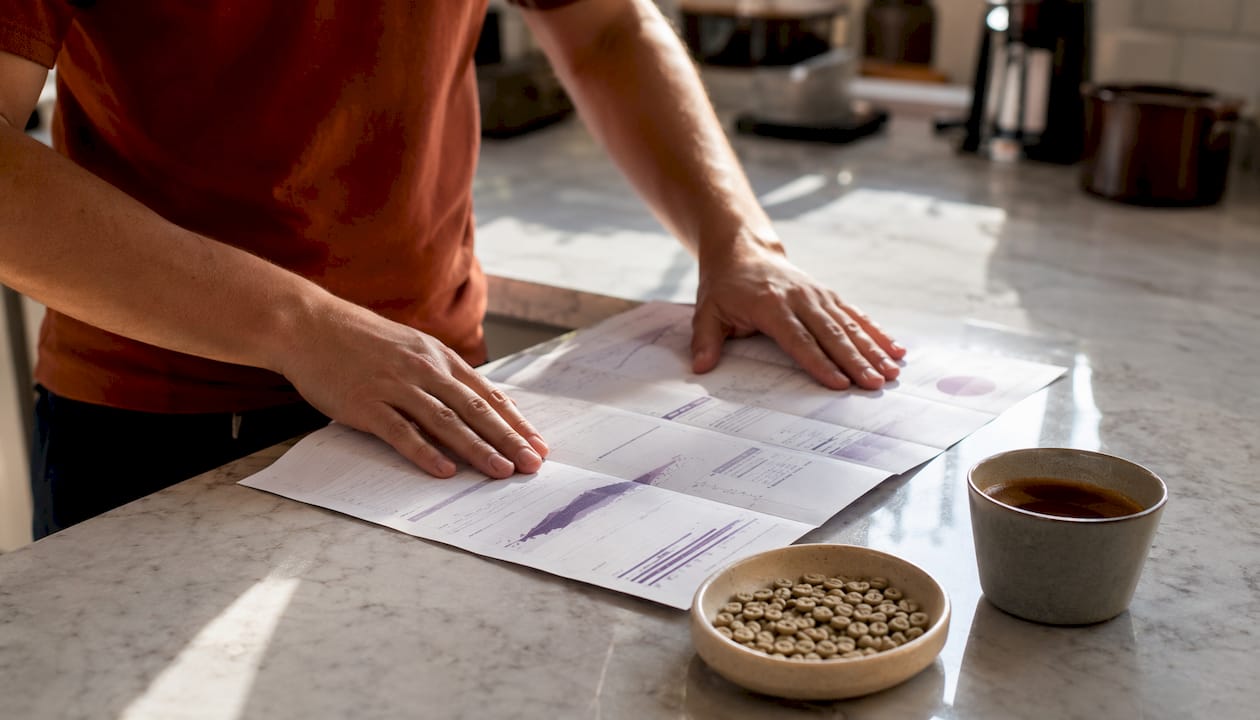
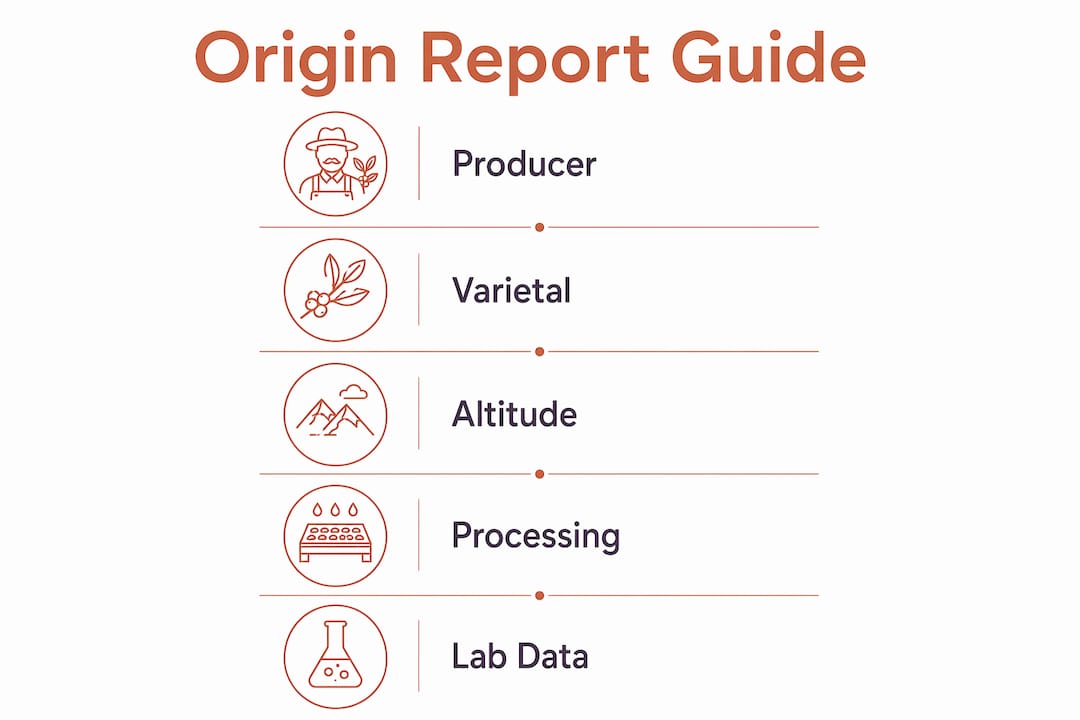
A coffee origin report is the farm-to-lot dossier that ties a specific lot number to its producer, region, processing method, sensory descriptors, and lab data. When you open one, scan these five items first:
- Roast date: If it’s missing, stop there. Freshness is non-negotiable.
- Lot number and traceability chain: A lot number without a trace chain is just a label.
- Cupping score and breakdown: Look for SCA-style subscores (aroma, acidity, body, balance), not just a headline number.
- Processing type: Washed, natural, honey, or anaerobic — each predicts a different cup.
- Lab numbers: Moisture content, defect count, and screen size tell you what the sensory notes can’t.
Modern origin analysis has moved well beyond tasting notes. Explainable AI models combining GC–MS volatile profiles with SVM classification can discriminate coffee origin with 91% accuracy and predict sensory intensity with an R² of 0.88. That’s not a lab curiosity — it’s the direction serious roasters are heading. Moustachecoffeeclub publishes origin-report details for every lot it ships, which is exactly the kind of transparency this guide will help you evaluate.
Table of Contents
- What does each field in an origin report actually tell you?
- How do you interpret tasting descriptors and cupping scores?
- How to use origin reports to choose beans or a subscription
- What red flags and trust signals should you look for?
- How are analytical chemistry and AI changing origin reports?
- What good origin reporting looks like in practice
- Key Takeaways
- Why experienced readers weigh reports differently now
- Fresh single-origin deliveries with transparent origin reports
- Useful sources
- FAQ
What does each field in an origin report actually tell you?
| Report Field | What to Look For | Red Flag |
|---|---|---|
| Producer / Farm | Named farm or washing station | “Various smallholders” with no further detail |
| Region | Sub-region or kebele/woreda | Country name only |
| Varietal | Named cultivar or contextual “Heirloom” note | Blank or “Arabica” |
| Altitude | Meters above sea level (masl) | No altitude listed |
| Processing | Washed, natural, honey, anaerobic | “Wet process” with no elaboration |
| Harvest / Lot Date | Specific crop year and lot ID | No date or lot number |
| Roast Date | Day-of-roast or ship date | Missing entirely |
| Certifications | Verifiable ID (Fair Trade cert number, USDA Organic cert) | Logo only, no ID |
| Lab Data | Moisture %, defect count, screen size | Absent or vague |
Producer and region specificity matters more than most buyers realize. A report listing “Yirgacheffe, Kochere kebele, Dumerso Washing Station” gives you a traceable supply chain. “Ethiopia” does not.
Varietal and “Heirloom”: Ethiopia’s coffee regions carry extraordinary genetic diversity, and roasters commonly label many native mutations as “Heirloom” because wild genetic variation creates complex, blended flavor profiles rather than a single named cultivar. Read “Heirloom” as a flavor-complexity signal, not imprecision — but a good report will add a contextual note explaining what that means for the specific lot. For more on Ethiopian variety flavor implications, the Ethiopian coffee varieties guide breaks it down by region.
Altitude shapes acidity and sweetness directly. Beans grown above 1,800 masl tend toward bright, complex acidity and floral or fruit-forward notes. Below 1,200 masl, expect softer acidity and more body-forward, chocolatey profiles.
Processing is where flavor diverges sharply. Washed coffees (pulped and fermented before drying) produce clean, bright cups where origin character shines. Natural-processed beans dry with the fruit intact, producing fruit-forward, wine-like sweetness. Honey processing sits between the two. Anaerobic and carbonic maceration are controlled fermentation methods that amplify specific flavor compounds — often tropical fruit or candy-like sweetness. Research confirms that volatile markers like linalool correlate with natural processing, while hexanal concentrations tend to be higher in washed lots.
Lab numbers: Acceptable green coffee moisture runs 10–12%. Defect counts above SCA Category 1 thresholds (5 full defects per 300g sample) should prompt questions. Screen size (grading) indicates bean density and uniformity, which affects roast consistency.
Pro Tip: Ask your roaster for the lot size. A 60kg micro-lot and a 600kg commercial lot carry very different consistency guarantees across a subscription.
How do you interpret tasting descriptors and cupping scores?
The SCA cupping framework scores ten attributes: aroma, flavor, aftertaste, acidity, body, balance, uniformity, clean cup, sweetness, and overall. A headline score of 87 tells you the coffee is specialty-grade; the subscore breakdown tells you why.
Practical descriptor-to-brew mappings:
- Floral, jasmine, bergamot: Light roast, pour-over or Chemex. These aromatics are heat-sensitive and disappear under dark roasting.
- Berry, stone fruit, tropical: Natural or honey process. Works beautifully as espresso or AeroPress at lower temperatures.
- Chocolate, hazelnut, almond: Medium roast, forgiving across brew methods. Good for French press or drip.
- Caramel, brown sugar, roasted: Medium-dark. Pulls well as espresso with milk.
Panel variance matters. A score from a single cupper is less reliable than one from a calibrated panel of three or more, especially when the report notes SCA protocol adherence. If the report doesn’t mention panel size or calibration, treat the score as directional, not definitive. Understanding why fruity tasting notes appear helps you cross-check whether the descriptors match the processing type listed.
Pro Tip: If a report claims high aroma intensity but the cupping score’s aroma subscore is modest (below 8.0), ask whether the intensity rating came from a lab measurement rather than a panel. Lab-measured volatile concentration and human-perceived intensity don’t always align.
How to use origin reports to choose beans or a subscription
The decision flow is simpler than it looks:
- Match descriptors to your flavor preference — fruity and bright, or chocolatey and smooth?
- Check roast date and roast style — ultra-light Nordic roasts preserve origin character; medium-dark roasts mask it.
- Confirm lot size and seasonality — small lots rotate; large lots offer consistency across a subscription cycle.
For subscriptions specifically, roast date is the single most important field. Beans roasted and shipped the same day arrive at peak degassing (typically 3–7 days post-roast for most brew methods). A report that omits the roast date or lists only a “best by” date is working against your interests.
Rotating single-origin subscriptions reward readers who understand origin reports. When a new lot arrives, compare its cupping notes and processing type to the previous one. If the roaster provides last-season cupping notes, request them — they show whether quality is consistent year over year for that producer relationship.
Pro Tip: Align your subscription cadence with your consumption rate, not just your preference. A 250g bag shipped every two weeks stays fresher than a 1kg bag shipped monthly, especially for light-roast single-origins where staling is more perceptible.
What red flags and trust signals should you look for?
Red flags:
- No roast date on the bag or report
- Provenance listed only at country level
- Lot numbers that change without explanation between orders
- “Heirloom” used as the only varietal descriptor, with no contextual note
- Certifications shown as logos only, with no verifiable certification ID
Trust signals:
- Roast date stamped on the bag, matching the report
- Lot number plus a traceable chain (washing station, cooperative, export partner)
- Roaster-authored origin-visit notes and producer photos
- Third-party certifications with verifiable IDs (Fair Trade USA, USDA Organic certificate numbers)
- Published lab data (moisture %, defect count)
To verify certifications, request the certification ID directly and cross-check it against the certifier’s public database. Fair Trade USA and the USDA National Organic Program both maintain searchable registries. For a deeper look at specialty coffee certifications and how to verify them, that guide covers the major programs. Traceability documentation — producer names, washing station IDs, and origin visit notes — is what separates a marketing story from a verifiable supply chain.
How are analytical chemistry and AI changing origin reports?
Modern lab tools go well beyond moisture meters. Three methods are reshaping what roasters can claim and verify:
| Method | What It Measures | Practical Use in Reports |
|---|---|---|
| GC–MS / HS-SPME | Volatile organic compound profiles | Origin discrimination, processing-type markers |
| PTR‑ToF‑MS | Real-time VOC fingerprinting | Genetic lineage and quality classification |
| 1H NMR | Metabolomic fingerprints | Geographic origin authentication |
GC–MS analysis shows that origin explains volatile composition more than post-harvest processing does — meaning origin markers survive roasting. PTR‑ToF‑MS studies across 1,132 samples found that quality correlates with specific pleasant VOC emissions, not total VOC count. And 1H NMR metabolomic fingerprinting can classify roasted Arabica by geographic origin down to country or region level.
Explainable AI ties these lab signals to sensory claims. SVM classifiers paired with SHAP analysis identify which volatile compounds drive origin classification and aroma intensity — making the link between a lab number and a tasting note transparent and reproducible.
Pro Tip: When a report includes a “volatile profile fingerprint” or “chemometric match” summary, ask the roaster for the plain-English version: which compounds are elevated, and what do they taste like? Raw chromatograms are useless without that translation.
What good origin reporting looks like in practice
Moustachecoffeeclub’s approach to origin reporting shows what subscription buyers should expect as a baseline. A well-constructed roaster report includes:
- Producer name and washing station (not just country or region)
- Roast date stamped on the bag, with day-of-roast shipping
- Lot number tied to a traceable chain of custody
- Cupping score with subscore breakdown (aroma, acidity, body, balance, sweetness)
- Processing detail (washed, natural, honey, or anaerobic with fermentation notes)
- Lab summary (moisture %, defect count, screen size)
- Origin visit notes or producer photos from the sourcing team
“Day-of-roast shipping means the origin report and the beans arrive together — the freshness claim is verifiable the moment you open the bag, supported by best practices in coffee packaging to preserve freshness and sustainability.”
Moustachecoffeeclub ships beans roasted to order in an ultra-light Nordic style, which preserves the volatile compounds that origin reports describe. That roast philosophy makes the sensory descriptors in the report more accurate, not less — light roasting retains the origin-specific aromatics that lab analysis identifies. For context on how origin shapes flavor complexity, that connection between terroir and the cup is worth understanding before you read your next report.
Key Takeaways
Reading coffee origin reports effectively comes down to five verifiable fields: roast date, lot number, cupping score breakdown, processing type, and lab data — any report missing two or more of these warrants skepticism.
| Point | Details |
|---|---|
| Roast date is the first check | A missing roast date is the single most common red flag in origin reports. |
| Cupping subscores beat headline scores | The SCA-style breakdown (aroma, acidity, body, balance) tells you more than the total score alone. |
| “Heirloom” needs context | In Ethiopian lots, Heirloom signals genetic diversity and flavor complexity — look for a contextual note. |
| Lab data validates sensory claims | AI models achieve 91% origin classification accuracy; volatile profiles confirm processing and origin markers. |
| Moustachecoffeeclub as a benchmark | Day-of-roast shipping, lot-level traceability, and Nordic-style roasting make origin-report claims verifiable at the bag. |
Why experienced readers weigh reports differently now
The conventional wisdom says to read the tasting notes first. Experienced enthusiasts read the roast date and lot number first, then the processing type, then the score breakdown — and treat the tasting descriptors as a hypothesis to test in the cup, not a guarantee.
Lab-backed summaries are changing that calculus further. When a report includes a volatile profile or chemometric match, it gives you a reproducible basis for comparing lots across seasons. A producer who scores 87 two years running with consistent processing and similar volatile markers is a genuinely reliable source. One who scores 87 once, with no lab data and a different processing method each season, is a different proposition entirely.
The gap between marketing copy and verifiable origin data is closing — but only for roasters willing to publish the detail. Subscription buyers who learn to read reports critically will consistently get better coffee, because they’ll know which roasters are doing the work and which are just telling a good story.
Fresh single-origin deliveries with transparent origin reports
Subscribers who care about origin transparency deserve more than a pretty bag and a vague tasting note. Moustachecoffeeclub ships beans on the day they’re roasted, so the origin report and the freshness claim are verifiable together — not just marketing language.
Every subscription includes roast-date labeling, lot-level origin notes, producer photos, brewing guides, and flexible cadence options. The ultra-light Nordic roast style preserves the volatile compounds that make origin reports meaningful — floral, fruity, and terroir-driven notes that heavier roasting would erase. Rotating single-origin selections mean each delivery comes with a new report to read and a new cup to compare.
Start your subscription and get your first origin report with your first bag.
Useful sources
These primary sources are worth bookmarking for anyone who wants to verify lab claims or dig into analytical methods:
- Explainable AI for Coffee Quality Control (MDPI Foods, 2025): The source for the 91% SVM accuracy and R² = 0.88 sensory intensity figures. Essential reading for understanding how AI links volatile compounds to cupping scores.
- Volatile Compounds in Green and Roasted Arabica Specialty Coffee (MDPI Foods, 2023): Covers HS-SPME/GC–MS discrimination of origins, processing types, and roast levels. Use it to verify processing-type volatile markers (linalool, hexanal).
- PTR‑ToF‑MS VOC Fingerprinting, Scientific Reports: The 1,132-sample study linking VOC profiles to genetic lineage and quality. Useful for understanding what “VOC fingerprint” means in a roaster report.
- 1H NMR Geographic Origin Classification (Food Chemistry): Explains metabolomic fingerprinting for origin authentication — cross-check any roaster claiming NMR-based traceability here.
- Project Origin: Ethiopia Yirgacheffe Report: Real-world example of station-level traceability documentation, including kebele/woreda identification and Heirloom context for Ethiopian lots.
- Bioactive Compounds and Trace Elements in Arabica Green Beans (JMBFS): Covers trace element profiles (Cu, Zn, Cr) and their use in regional differentiation — useful for understanding chemical origin authentication beyond volatiles.
Cross-check any certification claim against the Fair Trade USA or USDA National Organic Program registries before trusting a logo alone.
FAQ
What does an origin report mean in coffee?
An origin report is a producer-to-lot document that records provenance, processing method, cupping scores, and lab data for a specific coffee lot. It gives buyers a verifiable basis for freshness, quality, and traceability claims.
What is a good SCA cupping score for specialty coffee?
A headline score tells you the coffee is specialty-grade; higher scores indicate exceptional quality and outstanding lots, though exact thresholds vary.
How do I verify certifications listed in an origin report?
Request the certification ID number from the roaster, then search the certifier’s public registry — Fair Trade USA and the USDA National Organic Program both maintain searchable databases. A logo without a verifiable ID is not confirmation.
Why does “Heirloom” appear so often in Ethiopian coffee reports?
Ethiopia’s coffee regions carry extreme genetic diversity, and many native mutations don’t have single cultivar names. Roasters use “Heirloom” as a practical label for this complexity — it signals flavor diversity, not imprecision, but a quality report will include a contextual note explaining what it means for that specific lot.
Does Moustachecoffeeclub include origin reports with subscriptions?
Yes. Moustachecoffeeclub publishes lot-level origin notes, producer information, and roast-date labeling with every subscription delivery, shipped on the day of roasting.
Recommended
- Coffee Education Hub | Ultra-Light Nordic-Style Brewing Guides & Origins | Moustache Coffee Club
- How to Dial In Light Roast Coffee for Home Baristas | Blog | The Moustache Coffee Club
- How Brewing Method Affects Specialty Coffee Flavor | Blog | The Moustache Coffee Club
- What Is a Coffee Origin Story? A Complete Guide | Blog | The Moustache Coffee Club