Evaluating Coffee Freshness After Roasting at Home
Coffee freshness after roasting is defined as the window when beans deliver their fullest aroma, flavor complexity, and extraction quality. That window is narrower than most home baristas expect. Industry standards and specialty roasters recognize a peak freshness period of roughly 1–3 weeks after the roast date, though the exact range shifts with roast profile and storage conditions. Evaluating coffee freshness after roasting does not require a lab. Sensory cues like bloom vigor, aroma layering, and bean appearance give you reliable, repeatable signals every time you open a bag.
What are the key sensory indicators of coffee freshness after roasting?
The bloom test is the single most reliable freshness indicator you can perform at home. Pouring hot water over fresh grounds produces a vigorous, foamy rise as CO2 escapes from the bean’s cell structure. A weak or absent bloom tells you the gas has already dissipated, which means oxidation has taken over and peak flavor has passed.
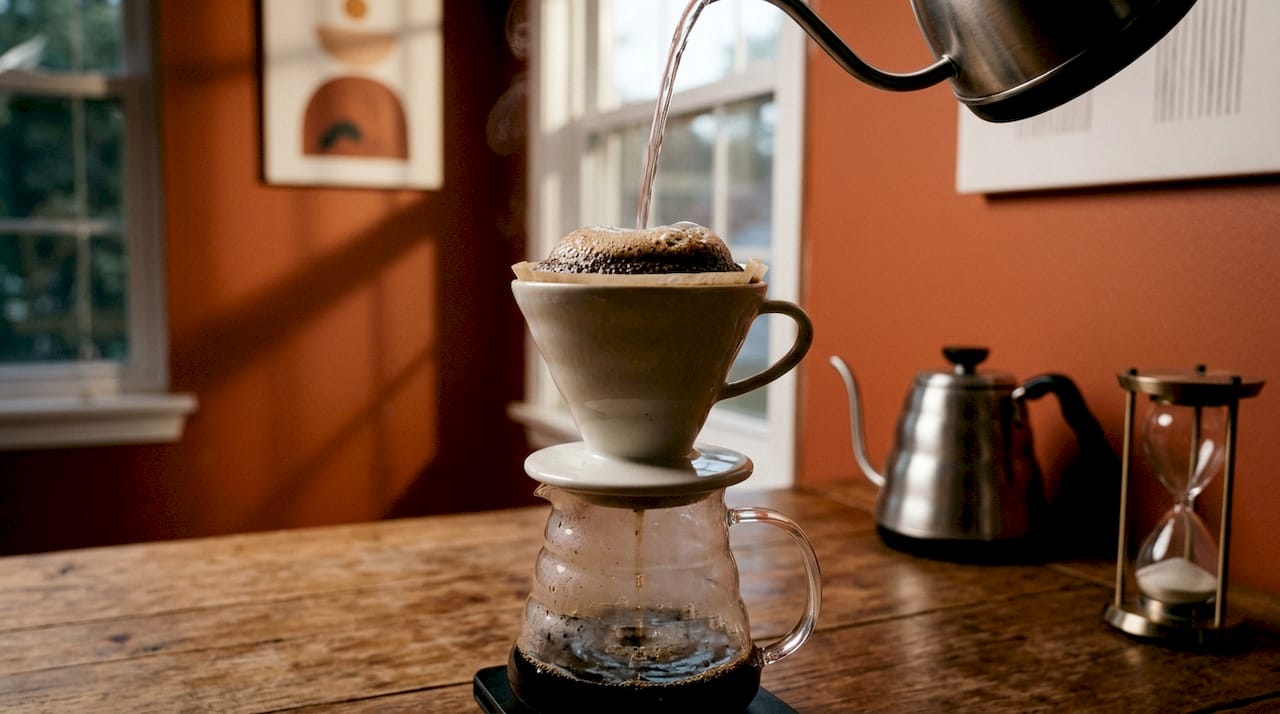
Aroma is the second major signal. Fresh beans carry complex, layered scents like chocolate, stone fruit, or florals depending on origin. Stale beans smell flat, papery, or faintly dusty. The difference is obvious once you train your nose to notice it.
Visual inspection adds a third layer of confirmation. Fresh beans show consistent color across the batch with no chalky patches or uneven fading. One common misconception worth clearing up: surface oiliness reflects roast level, not freshness. A dark roast will always show more surface oil than a light roast. Rancid or sticky oil on a light roast, however, signals poor storage or age.
- Bloom test: Look for a foamy dome that rises for 30–45 seconds after pouring.
- Aroma check: Grind a small amount and smell immediately. Complexity and brightness signal freshness.
- Color uniformity: Consistent color across beans indicates even roasting and proper storage.
- Surface oil: Normal on dark roasts; a warning sign on light roasts if sticky or rancid.
Pro Tip: Grind a small amount of beans and smell the grounds before brewing. Ground coffee releases aroma compounds faster than whole beans, making freshness signals easier to detect.
Which tools do you need for consistent freshness testing?
Reliable freshness evaluation requires controlled conditions. Without consistent brewing parameters, your bloom and flavor results will vary too much to be useful. The good news is that the tools you already use for brewing are the same ones you need for testing.
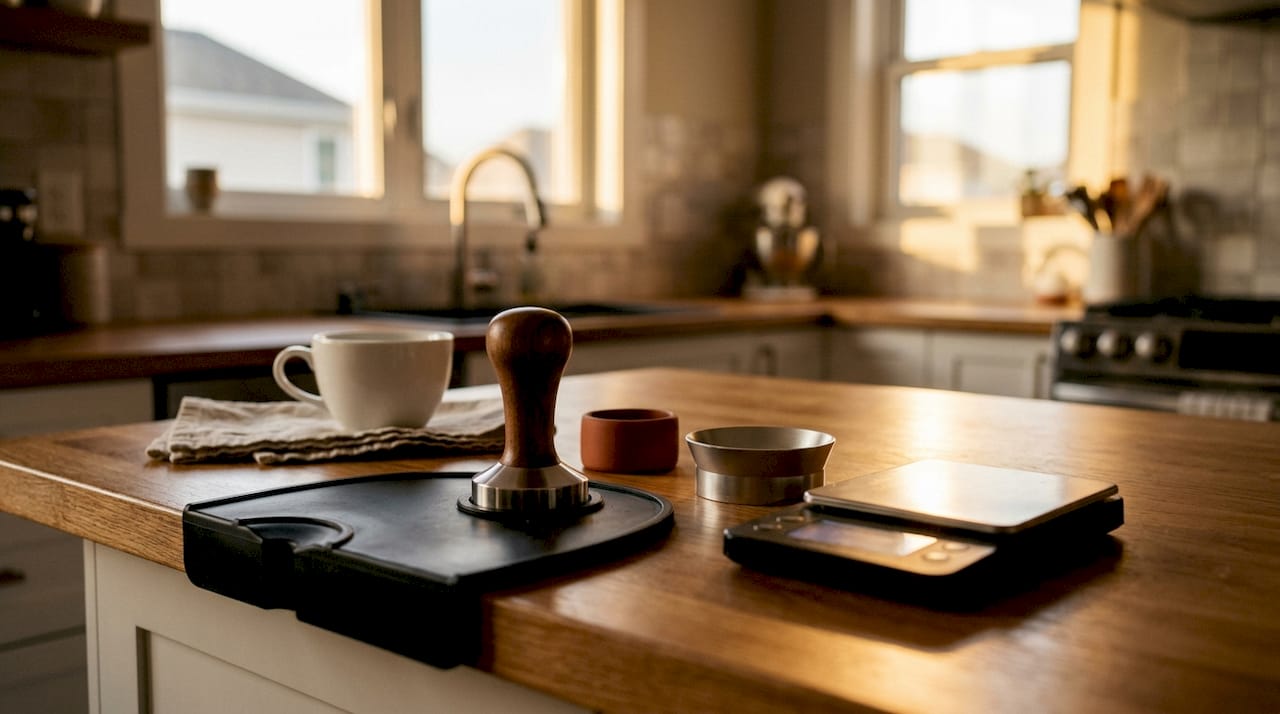
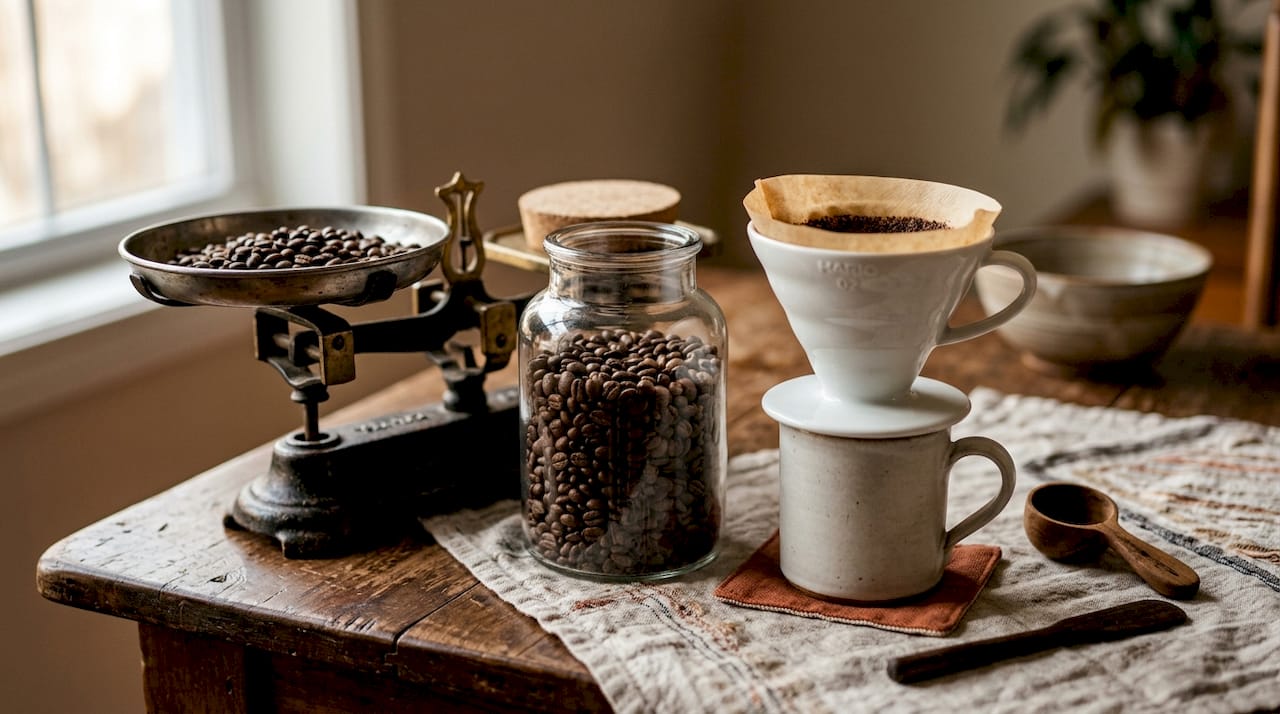
The core setup includes a kitchen scale accurate to 0.1 grams, a burr grinder, a gooseneck kettle with temperature control, a timer, and a clear glass or pour-over dripper. The clear vessel matters because it lets you observe the bloom visually without lifting the filter. A standard ratio of 1 gram of coffee per 15–17 grams of water gives you a consistent baseline for comparison across different bags.
| Tool | Basic Option | Advanced Option |
|---|---|---|
| Scale | Kitchen scale (1g accuracy) | Precision scale (0.1g accuracy) |
| Grinder | Blade grinder | Burr grinder with grind settings |
| Kettle | Standard stovetop kettle | Gooseneck kettle with temp control |
| Brewing vessel | Standard drip cone | Clear glass dripper for bloom observation |
| Timer | Phone timer | Dedicated brew timer with split function |
Store your test sample in an airtight container at room temperature for at least 24 hours before testing. Testing beans straight from the freezer or immediately after opening a vacuum-sealed bag introduces variables that skew your bloom results. Controlling for storage conditions before the test gives you a true read on the coffee’s actual freshness state.
When is the ideal time to assess coffee freshness post-roast?
Peak flavor typically occurs 5–21 days after roasting, after the bean has degassed sufficiently but before oxidation degrades its aromatic compounds. That range is not arbitrary. It reflects two distinct chemical phases that every roasted bean passes through.
The first phase runs from day 0 to roughly day 3. During this period, the bean releases high concentrations of methyl mercaptan (MeSH), a sulfur compound that creates raw, aggressive aromas. Coffee brewed in this window often tastes sharp and underdeveloped. Freshness is chemically defined by the ratio shift from MeSH to dimethyl disulfide (DMDS) compounds over time, with aroma stabilizing as DMDS increases between days 7 and 21. After day 21, aroma compounds flatten as oxidation takes hold.
The second phase, days 7–21, is where most specialty coffees hit their stride. Aroma becomes more stable and expressive. Extraction is more predictable. This is the window Moustachecoffeeclub targets when shipping roasted-to-order beans, so subscribers receive coffee at the start of its peak window rather than past it.
Storage conditions shift this timeline significantly. Temperatures above 30.7°C accelerate CO2 degassing, compressing the freshness window and pushing beans toward staleness faster. Keeping beans in a cool, dark environment at stable room temperature extends the usable window without freezing.
- Days 0–3: High MeSH; raw, aggressive aromas; not ideal for evaluation or drinking.
- Days 5–14: CO2 still present; bloom is vigorous; aroma is complex and layered.
- Days 14–21: Aroma stabilizes; extraction is consistent; optimal for most brew methods.
- Days 21+: Oxidation accelerates; bloom weakens; flavor flattens.
Pro Tip: Mark your bag with the roast date and test the same coffee on day 7, day 14, and day 21. You will taste the freshness curve directly, which builds a reference point no article can fully replicate.
How to perform a step-by-step freshness test at home
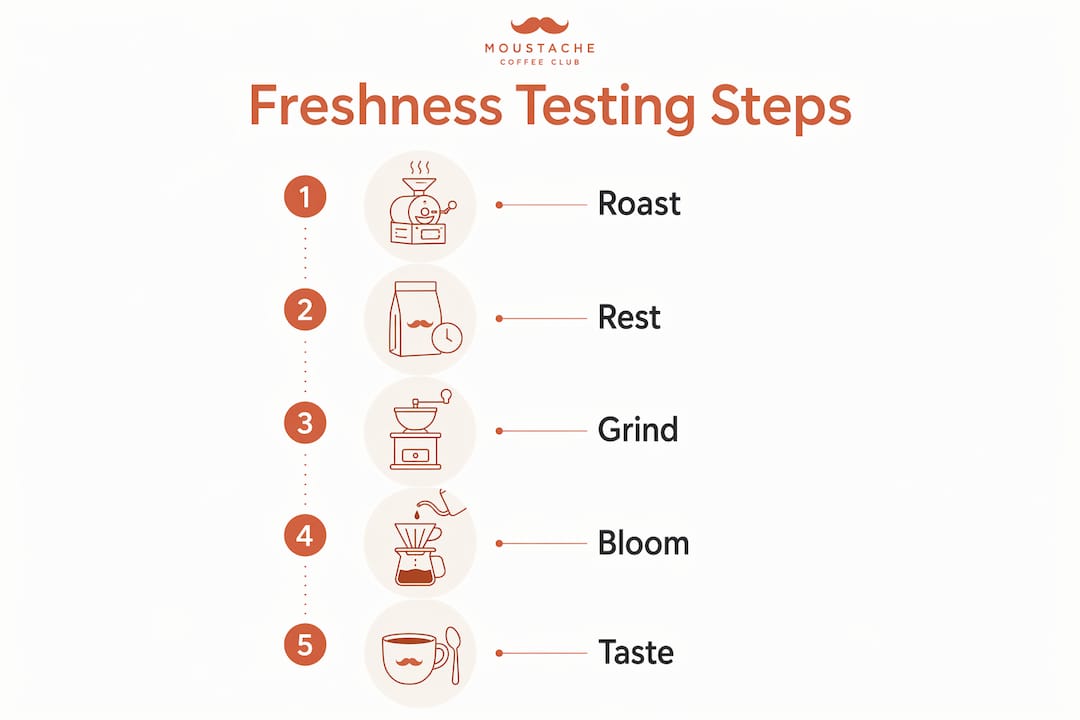
A structured testing routine removes guesswork and gives you repeatable results. Follow these steps each time you evaluate a new bag.
-
Check the roast date first. If no roast date appears on the bag, that is a red flag. Absence of a specific roast date signals a lack of freshness transparency from the roaster. Skip to sensory evaluation, but lower your expectations.
-
Grind a small dose. Use 18–20 grams for a standard pour-over. Grind to medium-fine and smell the grounds immediately. Fresh coffee smells bright and specific. Stale coffee smells generic and muted.
-
Heat water to 200°F (93°C). Temperature consistency matters. Water that is too hot or too cool affects CO2 release and skews your bloom reading.
-
Pour slowly over the grounds. Use just enough water to saturate the grounds, roughly 40–50 grams. Pour in a slow spiral from the center outward.
-
Observe the bloom for 30–45 seconds. Fresh coffee rises noticeably, forming a dome or foam. The stronger and longer the rise, the more CO2 is present, and the fresher the bean. A flat or barely moving bed signals staleness.
-
Complete the brew and taste for clarity. Expert baristas recommend assessing bloom and extraction flavor clarity as the most reliable freshness markers. Fresh coffee tastes bright, sweet, and specific to its origin. Stale coffee tastes flat, heavy, and bitter without sweetness.
-
Note your results. Write down the roast date, bloom strength, aroma notes, and flavor impression. Three or four tests across different bags builds a personal reference library that makes future evaluations faster and more accurate.
The most common mistake home baristas make is testing coffee on day 1 or 2 after roasting and concluding it tastes off. That sharpness is normal. Wait until day 5 at minimum before drawing conclusions about a coffee’s quality.
What should you do when freshness results are unclear?
Inconsistent results are common, and they usually point to one of three causes: roast level differences, origin characteristics, or storage variables. Understanding which factor is at play helps you interpret the signal correctly.
Roast level affects bloom intensity. Light roasts retain more CO2 than dark roasts at the same age, so a light roast will bloom more aggressively. A dark roast with a modest bloom at day 10 is not necessarily stale. Compare bloom strength within the same roast level, not across different ones. Learning to read freshness by roast level sharpens your evaluation accuracy significantly.
Bean origin also shapes aroma expectations. An Ethiopian natural process coffee smells fruity and fermented even when fresh. A washed Colombian smells cleaner and more floral. Knowing the processing method prevents you from misreading a characteristic aroma as a staleness signal.
Stale coffee tastes flatter, more bitter, and less sweet with a loss of bright high notes. If bloom is ambiguous but the cup tastes heavy and one-dimensional, staleness is the likely cause. Bright acidity and distinct flavor notes degrade first with oxidation, while bitter and heavy notes linger longer.
For home baristas who want a more objective read, non-destructive dielectric testing is an emerging method. Microwave-based dielectric measurement correlates with coffee acidity and oxidation, offering a physical measurement of freshness without destroying the sample. This technology is not yet consumer-accessible, but it confirms that sensory evaluation tracks real chemical changes.
- Buy small batches often. A 250-gram bag consumed within two weeks stays fresher than a 1-kilogram bag used over two months.
- Check for one-way degassing valves. Bags with these valves allow CO2 to escape without letting oxygen in, preserving freshness longer.
- Store away from heat. Keep beans below 30°C in an airtight container away from light and moisture.
- Avoid the freezer for daily-use coffee. Repeated freeze-thaw cycles introduce moisture and accelerate flavor loss.
Key Takeaways
Evaluating coffee freshness after roasting requires sensory testing, timing awareness, and controlled storage, not just a roast date on the bag.
| Point | Details |
|---|---|
| Bloom test is most reliable | A vigorous foamy bloom indicates high CO2 and genuine freshness in the bean. |
| Peak window is days 5–21 | Most specialty coffees hit optimal flavor after degassing but before oxidation sets in. |
| Aroma signals staleness clearly | Flat, dusty, or muted aroma after grinding is a direct indicator of oxidation. |
| Storage temperature matters | Keeping beans below 30°C preserves the freshness window and slows CO2 loss. |
| Roast date transparency is non-negotiable | No roast date on packaging signals the roaster is not prioritizing freshness. |
The roast date is a starting point, not the whole story
After years of working with specialty coffee, the most useful shift I made was treating the roast date as a starting point rather than a verdict. I used to open a bag on day 3, taste something sharp and underdeveloped, and assume the coffee was mediocre. That was wrong. The coffee was just not ready.
The bloom test changed how I buy and store coffee more than any other single habit. When I started documenting bloom strength alongside roast dates, I noticed that my storage setup was compressing my freshness window. My kitchen ran warm in summer, and beans stored near the stove were degassing faster than I expected. Moving storage to a cooler cabinet extended the window by nearly a week.
I also stopped chasing the freshest possible roast date and started chasing the right moment in the freshness curve. A coffee roasted 12 days ago and stored well often outperforms one roasted 4 days ago and stored poorly. Sensory evaluation taught me that. No app or label can replace the information your nose and palate give you when you grind fresh and pay attention.
If you want to build this skill faster, buy small batches from roasters who print the roast date clearly and ship beans roasted to order. That single practice removes the biggest variable: unknown time in transit or on a shelf.
— Sean
Fresh beans, every time, from Moustachecoffeeclub
Knowing how to evaluate freshness is only half the equation. The other half is starting with beans that give you a fair shot.

Moustachecoffeeclub ships single-origin specialty coffee roasted to order with a clear roast date on every bag. Each shipment arrives within your peak freshness window, so your bloom test has something to work with. The subscription also includes access to brewing guides and origin reports that deepen your understanding of what fresh coffee from Ethiopia, Colombia, and other origins should actually smell and taste like. If you have been working with beans that bloom weakly or smell flat, the difference a properly timed, transparently dated bag makes is immediate.
FAQ
What is the best way to test coffee freshness at home?
The bloom test is the most reliable method. Pour hot water over fresh grounds and watch for a vigorous foamy rise lasting 30–45 seconds. A weak or flat bloom indicates the coffee has lost most of its CO2 and is past its peak.
How long after roasting is coffee at its freshest?
Peak flavor occurs 5–21 days after roasting, after sufficient degassing but before oxidation degrades aromatics. Most specialty coffees are best between days 7 and 14.
What are the signs of stale coffee?
Stale coffee tastes flat, bitter, and lacks sweetness, with no distinct origin notes. Ground stale coffee smells dusty or papery rather than complex and bright.
Does oily coffee mean it is fresh?
No. Surface oiliness reflects roast level, not freshness. Dark roasts naturally show more oil than light roasts. Sticky or rancid oil on a light roast signals age or poor storage, not peak freshness.
Why does coffee taste sharp right after roasting?
Coffee releases high concentrations of sulfur compounds in the first 1–3 days post-roast, creating raw and aggressive aromas. Waiting until day 5 or later allows these compounds to stabilize and the coffee’s true flavor profile to emerge.
Recommended
- Receiving Roasted-to-Order Coffee: A Connoisseur’s Guide | Blog | The Moustache Coffee Club
- How to Store Whole Bean Coffee for Peak Freshness | Blog | The Moustache Coffee Club
- Why freshly roasted beans taste better: a guide | Blog | The Moustache Coffee Club
- How to Dial In Light Roast Coffee for Home Baristas | Blog | The Moustache Coffee Club