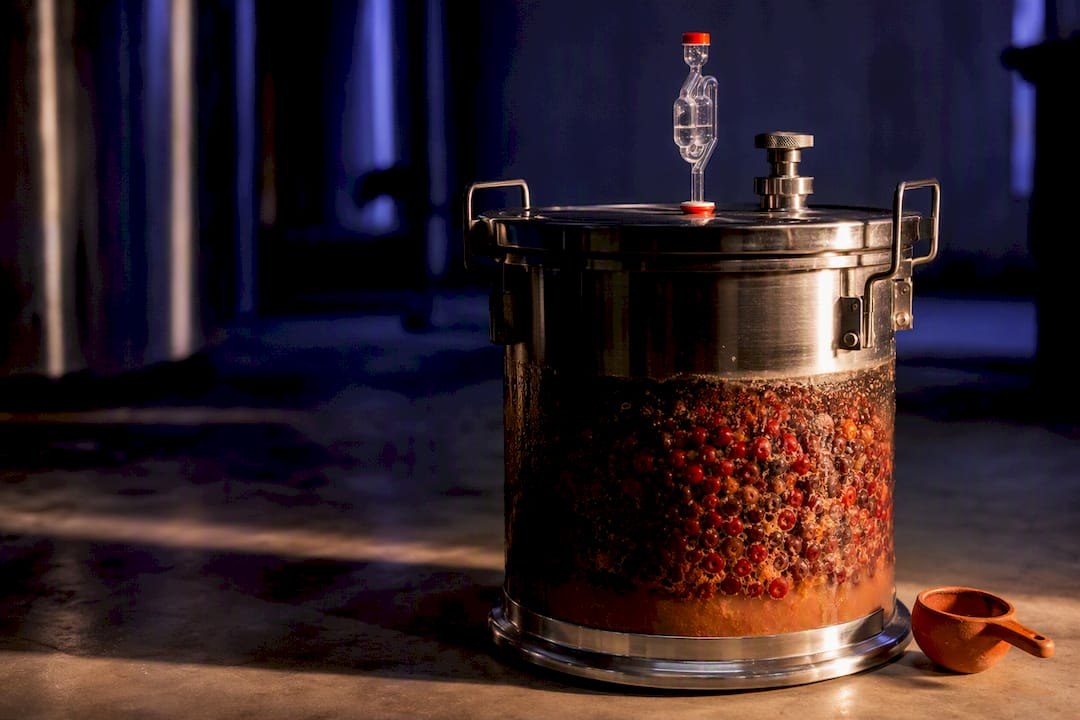
120 Hour Ferments: Roast and Brew Carbonic Maceration Coffee at Home

Carbonic maceration coffee starts with whole cherries sealed in a tank and flushed with CO2, so the fruit ferments from the inside before any outside microbes get involved. The result is usually a cup with loud aromatics, a bright lactic tang, and a body that feels almost syrupy. It’s also a coffee that punishes a heavy roast and a careless bag, so how it’s handled after fermentation matters nearly as much as the fermentation itself.
TL;DR:
- True carbonic maceration requires whole cherries sealed in tanks with active CO2 flushing and rigorous sanitation, making it more precise and costly than generic anaerobic processes.
- Fermentation duration and temperature, ideally maintained around 30°C for over 120 hours, significantly influence the coffee’s fruity, wine-like aromatics and body profile.
- Tank design and fill level affect fermentation consistency, with uneven pressure and crushing causing flavor variation between batches from the same farm.
- Proper post-fermentation drying and stabilization are critical to preserve delicate aromatics, with vacuum sealing being nearly mandatory for CM lots.
- These coffees are best brewed with pour-over methods at lower temperatures and enjoyed at multiple temperature stages to reveal their complex flavor layers.
Table of Contents
- What Is Carbonic Maceration in Coffee Processing?
- Carbonic Maceration vs. Anaerobic Fermentation: What’s the Real Difference?
- What Does Carbonic Maceration Coffee Taste Like?
- Time, Temperature, and Tank Design: The Variables That Actually Matter
- Drying, Stabilization, and Packaging: Where CM Coffee Can Fall Apart
- How to Brew and Cup Carbonic Maceration Coffee at Home
- What Can Go Wrong: Defects and Quality Checks
- How Moustachecoffeeclub Approaches Carbonic Maceration Lots
- Who Should Actually Buy Carbonic Maceration Coffee?
- Try a Carbonic Maceration Lot Through Moustachecoffeeclub
- Sources
- FAQ
What Is Carbonic Maceration in Coffee Processing?
Carbonic maceration (CM) is a fermentation method borrowed from winemaking, where producers load intact, unpulped cherries into a sealed tank and actively displace the oxygen with food-grade CO2. That single detail, whole fruit plus an active gas flush, separates true CM from generic anaerobic processing. Because the skin and pulp stay intact, fermentation begins inside each cherry rather than through microbes acting on exposed mucilage, a mechanism the Green Coffee Collective lays out clearly in its breakdown of the process.
The equipment is deceptively simple but unforgiving if neglected:
- Stainless steel or food-grade plastic tanks with a tight seal
- A one-way valve that lets built-up gas escape without letting oxygen back in
- A CO2 supply for the initial flush, sometimes topped up mid-fermentation
- Rigorous sanitation between batches, since leftover residue seeds off-flavors in the next lot
Because oxygen never really re-enters the tank, the fermentation happening inside the cherry runs on the fruit’s own enzymes and trapped sugars for a good stretch before yeasts and bacteria on the surface catch up. That intracellular head start is why CM lots taste so different from a standard washed or natural coffee fermented in open tanks.
Carbonic Maceration vs. Anaerobic Fermentation: What’s the Real Difference?
“Anaerobic” has become a catch-all term on green coffee listings, and that’s a problem for buyers trying to know what they’re actually purchasing. Anaerobic simply means fermentation without oxygen, which covers a wide range of setups, some using depulped cherries, some using open tanks that just happen to be covered. Carbonic maceration is a narrower, more specific technique within that category.
- True CM requires whole, intact cherries, never depulped fruit
- It requires an active CO2 flush, not just a sealed lid that traps ambient gas
- A lot labeled “anaerobic” may or may not be CM, and mislabeling is common enough that Barista Magazine specifically warns buyers to press for detail
- Ask suppliers directly: were cherries pulped before fermentation, and was CO2 actively introduced, or did the tank just sit sealed?
If a producer can’t answer those two questions, you’re likely looking at generic anaerobic fermentation wearing a trendier label.
What Does Carbonic Maceration Coffee Taste Like?
Expect a cup that reads more like fermented fruit than “coffee” in the traditional sense: floral top notes, tropical or stone fruit sweetness, sometimes berry or a faint winey, boozy edge underneath. The defining textural signature is a lactic acidity, sharp but rounded, paired with a body that feels denser and juicier than a washed coffee from the same farm.
Pro Tip: Let the cup cool past 130°F before you judge it. CM coffees tend to reveal a second, quieter layer of flavor as they drop in temperature, something that’s easy to miss if you only taste it scalding hot.

Studies on fermentation parameters show a strong link between conditions and outcome: work published in the journal covering sensory and chemical modulation in Coffea arabica found that certain time and temperature combinations meaningfully shift both the volatile compound profile and cupping scores. On the roast side, this coffee rewards restraint. Push development too far and you flatten the aromatics that make CM worth seeking out in the first place; a shorter, gentler roast tends to preserve the top-note complexity while still resolving enough acidity to keep the cup from tasting sharp or unripe.
Time, Temperature, and Tank Design: The Variables That Actually Matter
Fermentation length and heat drive most of the variation you’ll taste between CM lots. Research cited by the Green Coffee Collective points to roughly 30°C sustained for more than 120 hours as a window that favors the formation of desirable esters, the compounds behind a lot of that fruity, wine-like character. Shorter or cooler ferments tend to produce a cleaner, more restrained cup; longer, warmer ones push toward funkier, boozier territory.
Tank geometry matters more than most home roasters assume:
- Fill height changes the pressure and gravity gradient inside the tank
- Cherries at the bottom get gently crushed under the weight above them, which speeds up their fermentation relative to fruit near the top
- That uneven crushing is one reason a single lot can show flavor variation from batch to batch, a dynamic Daily Coffee News has documented in producer interviews
- Some producers add water partway through as a deliberate endpoint marker, watching for foaming at the valve as a signal fermentation has run its course
Pro Tip: If you’re comparing two CM lots from the same farm and tasting inconsistency between bags, ask the importer about tank fill level. A half-full tank and a packed tank from the same fermentation schedule can produce noticeably different cups.
Drying, Stabilization, and Packaging: Where CM Coffee Can Fall Apart
Fermentation is only half the job. What happens in the days after determines whether those delicate aromatics survive the trip to your grinder. Depulping has to happen carefully once fermentation ends, followed by a slow, controlled drying period and a rest or stabilization window before the coffee ever gets bagged for export.
- Rushed drying locks in uneven moisture and can trigger secondary, unwanted fermentation
- A stabilization rest lets moisture even out through the bean before packing
- Hermetic liners or vacuum sealing are close to mandatory for CM lots, since these coffees carry more volatile compounds than a standard washed lot, a point MTPak Coffee makes repeatedly in its guidance for roasters
- On arrival, check for a noticeably different green color or a more pronounced aroma straight out of the bag compared to conventional lots, both are normal, but a flat or musty smell is a red flag
For a fuller picture of everything that happens between the tree and your cup, Moustachecoffeeclub’s guide to how a cherry becomes a roasted bean walks through the stages in more depth.
How to Brew and Cup Carbonic Maceration Coffee at Home
CM coffee shows best in methods that let aromatics escape rather than methods that flatten them under pressure or heavy body. Here’s a straightforward approach:
- Start with a pour-over using a paper filter, which lets the floral and fruit notes come through clean.
- Grind slightly coarser than your usual pour-over setting to avoid over-extracting the lactic acidity into something sour.
- Use a 1:16 coffee-to-water ratio and water around 200°F, a touch cooler than you’d use for a washed coffee.
- Taste hot first, then again at room temperature, tracking how the flavor shifts as it cools, since that’s where CM coffees often show their most interesting layers.
Pro Tip: Keep a running note of what you taste at each temperature stage. CM coffees change so much as they cool that a single tasting note taken hot will miss most of the story. If the acidity feels too sharp, a slightly finer grind and shorter brew time will tame it; if the cup tastes muted, try a coarser grind to let more aromatics through. For more on how method choice shapes what you taste, see Moustachecoffeeclub’s guide to brewing method and flavor.
What Can Go Wrong: Defects and Quality Checks
Carbonic maceration is unforgiving when it’s mismanaged. Fermentation left running too long or at the wrong temperature produces vinegar or nail-polish solvent notes, while an interrupted or uneven ferment can leave a lot tasting dry and astringent on the finish.
- Smell the green beans on arrival; a sharp vinegar or paint-thinner odor signals overfermentation before you ever put it in a roaster
- Run a small test roast and cup it before committing a full batch to production
- Expect some lot-to-lot variation even from a careful producer, since tank gradients make total uniformity almost impossible
- True CM requires real investment (dedicated tanks, CO2 supply, careful monitoring), which is part of why well-executed lots command a premium over cheaper “anaerobic” coffee riding on the same buzzword
How Moustachecoffeeclub Approaches Carbonic Maceration Lots
Moustachecoffeeclub’s ultra-light, Nordic-style roasting approach is built for coffees like this, where the goal is preserving aromatics rather than masking them under heavy development. When a carbonic maceration lot enters the lineup, subscribers get full origin notes, the actual roast level applied, and brewing guidance specific to that coffee rather than generic instructions. For more on reading and recording what you’re tasting, the specialty coffee tasting notes guide is a useful companion.

Who Should Actually Buy Carbonic Maceration Coffee?
This coffee is for people who like cupping, tweaking their roast, and chasing flavor complexity over consistency. If you want a dependable, inexpensive daily driver, skip it, CM lots cost more and vary more than a standard washed coffee. If you’re curious, buy a small bag, taste it hot and cooled, take notes, and adjust your next brew based on what you found.
— Sean
Try a Carbonic Maceration Lot Through Moustachecoffeeclub
Sourcing a well-executed carbonic maceration lot on your own means chasing down importers, reading vague listings, and hoping the “anaerobic” label on a bag actually means what you think it means. Moustachecoffeeclub cuts that guesswork out by curating small-batch lots directly, roasting them ultra-light to protect the aromatics this process is known for, and pairing every bag with real origin notes and brewing guidance built for that specific coffee.

New subscribers pick a plan, get beans roasted to order rather than sitting on a shelf, and can flag preferences so future selections lean toward fruit-forward, fermentation-driven cups if that’s what you’re after. When a carbonic maceration lot lands in rotation, you’ll know exactly what you’re getting: process detail, roast level, and how to brew it. Join Moustachecoffeeclub and get the next fresh-roasted lot sent to your door.
Sources
- Carbonic Maceration Coffee: What It Is and How It Works – Green Coffee Collective
- Modulation of the sensory and chemical profile of Coffea arabica grown in transition zones through carbonic maceration fermentation - ScienceDirect
- Understanding the Process: Carbonic Maceration - Barista Magazine
- Carbonic maceration in coffee: the ultimate guide for roasters - MTPak Coffee
FAQ
What Does Carbonic Maceration Do to Coffee?
It ferments the cherry from the inside out by sealing whole fruit in a CO2 flushed tank, which produces stronger aromatics, a lactic tang, and a heavier, juicier body than standard processing methods.
Is Carbonic Maceration the Same as Anaerobic Coffee?
No. Anaerobic is a broad category covering any oxygen-free fermentation, while carbonic maceration specifically requires intact whole cherries and an active CO2 flush, a distinction Barista Magazine notes is often blurred on green listings.
How Long Does Carbonic Maceration Take?
Fermentation time varies by producer and desired flavor outcome, but research has linked roughly 30°C sustained for more than 120 hours to favorable ester development and stronger sensory scores.
What Are the Four Enemies of Coffee?
In roasting and storage terms, the four most cited threats to freshness are oxygen, light, heat, and moisture, all of which is why hermetic or vacuum packaging matters even more for delicate carbonic maceration lots than for standard coffee.
Why Does Carbonic Maceration Coffee Taste Different as It Cools?
The volatile compounds formed during fermentation evaporate and shift at different rates as temperature drops, which is why tasters often describe CM coffee as showing a second, subtler flavor layer once the cup cools.